
Mit érdemes használni a kert talajának javítására?
Compost, Organic Manure, or Soil Conditioner? What Should You Use to Improve Your Garden Soil?
Anyone who wants to grow healthier, more beautiful vegetables, fruits, flowers, or ornamental plants will sooner or later face the same question: should I use compost, organic manure, or a soil conditioner?
These three options serve different purposes, so it is worth taking a closer look at what each product actually is and what role it plays in the garden. Once we understand the differences, it becomes much easier to identify what our garden needs and choose the most suitable product or combination of products.
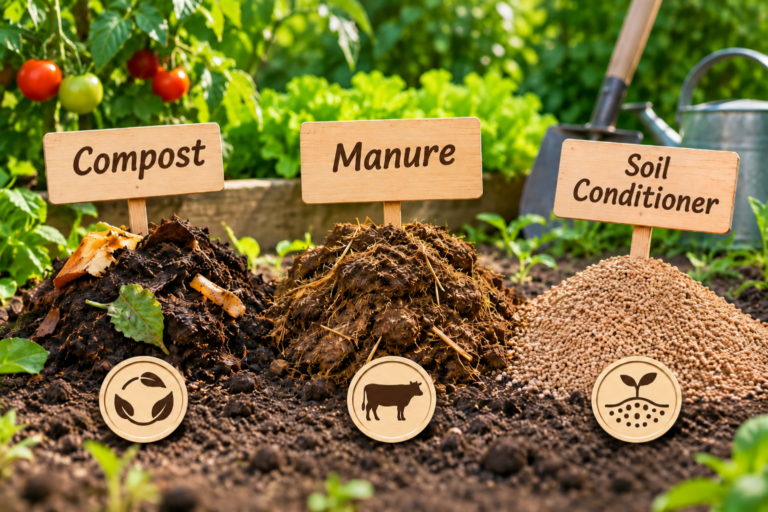
Compost is primarily a source of organic matter and can play an important role in improving soil structure. Organic manure supplies both nutrients and organic matter to the soil. Soil conditioners, on the other hand, are mainly designed to improve and maintain favorable soil conditions.
Let’s explore when and why each of these options may be useful in your garden!
1. Compost – When You Want to Return Organic Matter to the Soil
Compost is a crumbly, organic matter-rich material produced through the decomposition of garden and household organic waste under suitable conditions. Making your own compost is also an excellent way to return some of the plant residues generated in your garden to the natural nutrient cycle.
High-quality compost can be used for:
- Improving soil in vegetable gardens
- Flower beds
- Around fruit trees and shrubs
- Preparing soil before transplanting seedlings or planting
- Establishing new garden beds
The organic matter in compost helps improve soil structure. It can be particularly beneficial for soils with low organic matter content, making it a valuable part of regular soil care.
What Should You Pay Attention To?
Compost quality is extremely important. There is a significant difference between using properly matured, stable compost and adding organic material that is still actively decomposing.
Compost is therefore much more than simply “garden waste.” It is an organic material that becomes truly suitable for soil application once it has matured properly.
2. Organic Manure – When Nutrient Supply Is Also Important
Organic manures, such as well-rotted farmyard manure, can also play a significant role in maintaining soil fertility. Organic manure can provide both organic matter and nutrients. In vegetable gardens, adequate nutrient availability is particularly important because vegetable crops regularly remove substantial amounts of nutrients from the soil. However, when applying organic manure, both the quantity and quality of the material must be considered. Fresh manure is not always suitable for direct application near plants. Using properly matured organic manure is generally a safer and more predictable solution.
More Is Not Always Better
The principle that “the more, the better” does not necessarily apply to gardening. Excessive application of organic matter or nutrients can disrupt the soil’s natural balance. It is therefore advisable to adjust application rates to the needs of the plants and the existing condition of the soil.
3. Soil Conditioner – Neither Fertilizer nor Compost
The primary purpose of a soil conditioner is not to replace compost or organic manure. A soil conditioner is a product designed to positively influence certain physical, chemical, or biological properties of the soil. Different soil conditioners can vary considerably in their composition and mode of action. Some are based on organic matter, others contain mineral ingredients, while certain products combine both.
Before purchasing a soil conditioner, it is always worth checking:
- What the product is made from
- Which ingredients it contains
- What applications the manufacturer recommends
- The recommended application rate
- Which crops or plants it is suitable for
What Is the Difference in Simple Terms?
To put it very simply:
Compost is primarily a source of organic matter that can be used to improve soil structure.
Organic manure can supply both organic matter and nutrients to the soil.
A soil conditioner is primarily a product designed to improve and maintain favorable soil conditions.
However, it is important to remember that these categories can overlap. Some soil conditioners may contain substantial amounts of organic matter, while certain organic manures can also influence the physical properties of the soil.
Which One Should You Choose for Your Garden?
The answer mainly depends on the problem you want to address. If your goal is to return organic matter to the soil, compost may be a good choice. If you want to supply both nutrients and organic matter, properly matured organic manure may be the right solution. If you want to improve specific aspects of soil condition, it may be worth considering a soil conditioner. And, of course, all three can form part of a well-planned garden soil management program.
Why Is Soil Structure Important?
For plants, it is not only the amount of nutrients in the soil that matters. Soil structure and water management are equally important. In well-structured soil, water can move more effectively, while the roots can develop in a more favorable environment. By contrast, compacted soil with poor structure is more difficult to cultivate and may restrict root development. This is why proper soil care involves much more than simply replenishing nutrients.
Healthy Gardening Starts with Healthy Soil – The Humikal Universal Product Range for Home Gardens
Humikal Universal Classic Granules can be used as a soil conditioner to support soil care in home gardens. In addition to humic acid-rich organic matter, the product also contains dolomite and zeolite. This combination can play a role in soil management practices aimed at improving the physical and chemical properties of the soil. Humikal Universal is not simply a substitute for compost or organic manure. It serves a different purpose and can therefore be used alongside organic matter replenishment as a complementary part of garden soil management. It may be particularly useful when the goal is not merely to supply nutrients but also to pay closer attention to overall soil condition.
What If You Have Only Recently Started Composting or Maturing Organic Manure and Want to Use It in Your Garden as Soon as Possible?
Treating Compost and Organic Manure with Humikal Universal Products
Humikal Universal Classic Granules and Humikal Universal Classic Liquid can also be incorporated into organic matter management practices during composting and organic manure treatment. Humic acid-based products may help create more favorable conditions for the transformation of organic materials while contributing to better utilization of the valuable organic matter contained in compost and manure.
Humikal Universal Classic Granules: Can be applied when building up layers in a compost or manure pile, or mixed directly into the organic material.
Humikal Universal Classic Liquid: Can be applied to the organic material being treated by spraying or other methods that ensure even distribution.
The purpose of these treatments is to support the transformation of organic matter, promote its stabilization, and help produce a more homogeneous, easier-to-handle compost or organic manure. Humikal Universal does not replace compost or organic manure. Instead, it can serve as a complementary component of their treatment and overall organic matter management.
Compost + Organic Manure + Soil Conditioner?
As we have seen, you do not necessarily have to choose just one. The goal in a healthy garden is not to expect a single product to do everything, but rather to adapt soil management practices to the condition of the soil and the needs of the plants. Compost can help replenish organic matter, organic manure can provide both nutrients and organic matter, and a suitable soil conditioner can contribute to creating and maintaining more favorable soil conditions. These three options are therefore not necessarily competitors.
The real question is: What does your soil need?
Once you know the answer, it becomes much easier to decide what to apply, when to apply it, and in what quantity.
A Healthy Garden Starts with the Soil
A productive vegetable garden, healthy fruit trees, and flourishing flower beds depend on more than choosing the right plants and providing adequate irrigation. Over the long term, soil condition plays a crucial role in determining the environment in which plants grow and develop. That is why it is worth caring for your soil regularly, rather than waiting until problems become visible.
Don’t just care for your plants – take care of your soil, too!