
In modern fruit production, soil health, humus levels and nutrient availability have become crucial factors for long-term productivity. A comparative soil analysis carried out in a sour cherry orchard in Érd clearly shows how Humikal Universal Classic Granulate, a humic acid–based treatment, performs compared to a control plot treated with NBPT-stabilized urea.
The results highlight the significant role humic acid plays in improving nutrient availability, enhancing soil structure, and supporting a healthier root environment.
Macronutrients: Significant Improvements on the Treated Area
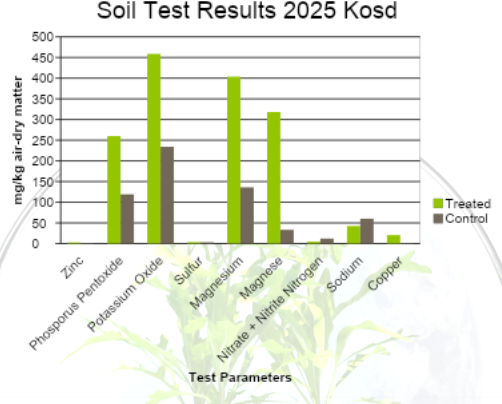
Two key macronutrients, phosphorus and potassium, showed remarkable increases in the humic-treated parcel:
Available phosphorus increased by 118%
Available potassium increased by 96%
In contrast, nitrite+nitrate nitrogen levels were 37% lower. Although this seems negative at first glance, it actually indicates better nutrient uptake and utilization: the nitrogen is not accumulated as residue but incorporated efficiently by the plant.
Micronutrients: Strongly Improved Availability with Humic Acid
Micronutrient levels also improved significantly on the treated plot:
Zinc: +60%
Sulfur: +11%
Magnesium: +197%
These increases highlight the chelating properties of humic acid, which enhances the solubility of micronutrients and reduces their fixation in the soil.
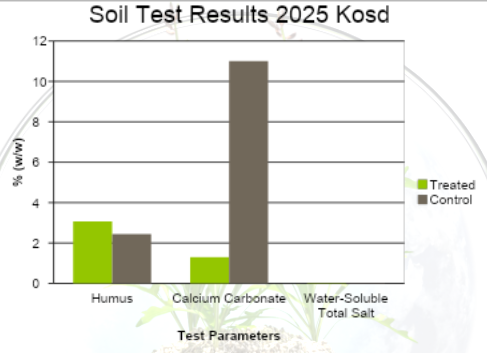
Humus Content: The Engine of Soil Life
Humus levels were 25.8% higher in the treated area.
Humic acid promotes the formation of stable humus complexes by binding organic matter with mineral fractions.
By comparison, stabilized urea provides nitrogen but does not stimulate humus formation—and may even reduce humus levels over time.
Calcium Carbonate (CaCO₃): Lower Carbonate Binding in Treated Soil
The control area showed significantly higher CaCO₃ levels.
Humic acid can bind carbonates, which results in:
reduced nutrient fixation
improved availability of micro- and meso-elements
higher overall nutrient solubility
Urea does not influence these processes, so high carbonate binding remains in the control.
Water-Soluble Salts – Favorable Results in Both Treatments
Both areas showed low water-soluble salt content.
This is expected with NBPT-treated urea, where slow nitrogen release prevents salt accumulation—an advantageous condition for soil biology and root development.
Comparison Before and After Treatment
Compared to pre-treatment soil samples, the following positive changes were observed:
Macronutrients:
Phosphorus: +0.7%
Potassium: +3.3%
Nitrite+nitrate nitrogen: –33.7%
Micronutrients:
Zinc: +30%
Manganese: +7%
Copper: +58%
Humus content increased by 10%, contributing to long-term soil improvement and enhanced fertility.
Why Is Humic Acid More Effective Than Urea Alone?
Humic acid supports soil functions in a complex way:
Boosts humus formation
Reduces carbonate binding (more available micronutrients)
Chelates and mobilizes nutrients (Zn, Mn, Cu, Mg, etc.)
Improves soil structure and water balance
Supports long-term soil regeneration
Urea, on the other hand, primarily provides nitrogen but does not enhance humus levels or improve nutrient solubility and soil structure.
Conclusion: Clear Advantages of Humic Acid Treatment
Based on the soil test results, Humikal Universal Classic Granulate provides the following benefits for the sour cherry orchard in Érd:
increased humus levels
improved macronutrient and micronutrient availability
lower carbonate-induced nutrient binding
better soil structure and water retention
long-term soil regeneration
Humic acid is therefore not just a nutrient source—it is a comprehensive soil-enhancing solution, essential for the sustainability and productivity of long-lived fruit orchards.